
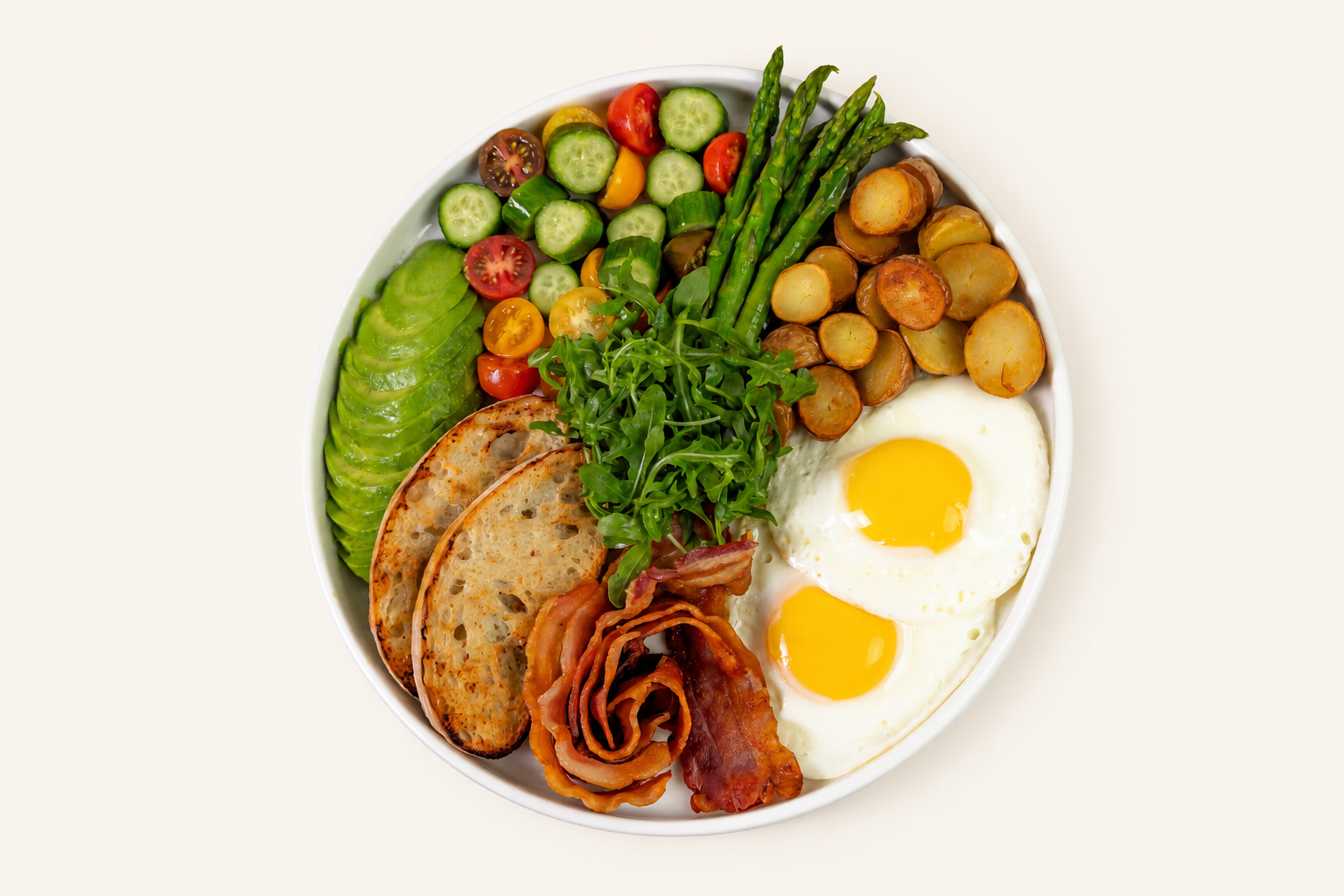
The Ultimate Breakfast is one of the best selling items. The Avocado Bruschetta as well. Guests ordered them, enjoyed them, and came back for them. By the most obvious measure — customer demand — they were successes.
We had to remove them anyway.
This post is the explanation. Not a marketing explanation — the actual one, with the numbers and the reasoning and the honest admission that running a café means making decisions that disappoint some guests in order to build something that works long term.
What popularity doesn't tell you
A dish that sells well is not necessarily a dish worth keeping. This is one of the least intuitive things about running a food business, and one of the most important things to understand.
Sales volume tells you that guests want the item. It doesn't tell you whether you can produce it consistently at the quality level it requires. It doesn't tell you what it actually costs — in ingredients, in labor, in the time it takes away from everything else happening in the kitchen during the same service. It doesn't tell you whether the price you'd need to charge to make it viable is a price your guests will pay.
The Ultimate Breakfast and the Avocado Bruschetta failed all three of those tests. Not because the food was wrong — because the economics and the operational reality were wrong for our format.
The labor problem
Both dishes are built almost entirely from fresh components prepared at the moment of order. That's what makes them good. It's also what makes them operationally expensive in a way that doesn't show up on the ingredient cost line.
Every Ultimate Breakfast required eggs cooked to order, fresh potatoes, asparagus, avocado prepared in the moment, protein handled separately. Every Avocado Bruschetta required fresh avocado prepared to order, components assembled to a standard that doesn't tolerate pre-prep. These are not dishes you can set up in the morning and execute quickly throughout service. They demand kitchen time at the exact moment when the kitchen is already under pressure.
In a full restaurant with a larger kitchen team, this is manageable. In a café format with our current team and kitchen, these dishes were consuming a disproportionate share of capacity every time they were ordered — slowing down everything else, creating pressure that accumulated across the service, and making it harder to maintain the standard on items that are faster to execute.
The guest who ordered the Ultimate Breakfast got a good experience. The guests waiting for other dishes sometimes got a slower one. That trade-off is not one we're willing to make permanently.
A dish that sells well is not a dish worth keeping if producing it costs you more than it returns — in money, in time, or in what it takes away from everything else.
The pricing reality
We spent the past several months doing something we should have done more rigorously before we opened: calculating the true cost of every item on the menu. Not just ingredient cost — the full picture, including the labor hours that go into preparation, assembly, and service for each dish.
When we ran those numbers honestly, the Ultimate Breakfast told a clear story. To price it at a margin that makes the dish viable — covering ingredients, the labor to produce it, and a contribution to the overhead it generates — the price would need to be around $40–45. That's not a café price. That's a dinner restaurant price. And at $45, the sales volume that made the dish seem successful would collapse (I could be wrong here). We'd be producing a complex, time-intensive dish for two or three tables a day, at a price point that makes guests feel they're in the wrong place.
There is no version of the Ultimate Breakfast that works in our current format. The dish is genuinely good. The economics are genuinely broken. Keeping it on the menu would have meant either charging a price that alienates guests or absorbing a loss on every plate — neither of which is a business decision, it's a slow way to fail while looking busy.
The cents decision
While we were recalibrating the menu, we also changed how we price everything. We removed the cents.
This is a small thing that turns out to matter. A price of $12.75 reads as calculated — as a number that was arrived at by working backwards from cost and adding a margin to four decimal places. A price of $13 reads as a decision. It communicates confidence. It says the item is worth this, not that we've optimised the price to the nearest quarter.
There's also something about cents in a specialty context that works against the positioning. High-end restaurants don't price at $34.95. They price at $35. The cents signal a certain kind of value calculation that doesn't belong in the same category as carefully sourced ingredients and in-house production. We want our prices to feel considered, not calculated. Removing the cents is a small part of that.
The standard we are not willing to lower
There is one more reason these dishes had to stay or go — and my friend from Sarasota made the point better than we could.
He drove in specifically to try the Ultimate Breakfast. After the meal, he sent me two photos side by side: a screenshot of the dish from our menu on the website, and a photo of what arrived at his table. They were identical. Same composition, same proportions, same presentation. His message said he had never seen that before — a restaurant where the food actually looked like the photo.
That detail matters more to me than any five-star review. It means the standard we photographed is the standard we produce. Not a styled shot made for the camera, not an aspirational image of something we achieve on good days — the real dish, every time. Are we able to deliver this standard every single time –– no. But we are aiming for it.
This is precisely why removing the Ultimate Breakfast was the only honest choice. We cannot produce it at a price that makes sense for our format. And we will not produce it at a lower standard just to make the economics work. If a dish is on our menu, it looks like the photo — every time, for every guest. If we cannot guarantee that, it comes off the menu. There is no middle option.
What replaces what we removed
The direction we're moving in for food is items that can be prepared efficiently in advance and finished quickly at service — without compromising freshness or quality.
The Chicken Caesar Wrap is the model. Prepared thoughtfully before service, finished to order, consistent every time, fast enough that it doesn't create bottlenecks. That's the format we're building toward. Items where the morning prep does the heavy work and the service execution is clean.
We're developing new items in this direction — things that fit the café format properly, that we can produce at a quality level we're proud of, and that we can price honestly without either losing money or charging restaurant prices for café food. We'll add them to the menu when they're right, not before.
The honest version of why this matters
We are not a restaurant. We are a specialty café with an in-house bakery and a food program that we take seriously. Those are different things, and the menu should reflect what we actually are — not what we thought we might be when we opened, or what some guests wish we were.
A café that tries to be a full-service restaurant without the kitchen, the team, or the economics to support it ends up doing both things poorly. The coffee suffers because the kitchen is chaotic. The food suffers because the format isn't designed for it. The experience suffers because the team is stretched across two formats simultaneously.
We would rather do fewer things at a level we're genuinely proud of than more things at a level we're constantly apologising for internally. The guests who loved the Ultimate Breakfast — we understand the disappointment. We hope what's coming makes up for it.
The menu will keep evolving. We'll keep writing about why.