
We gathered as a team several times already to prepare for one of the biggest operational shifts Three Sixteen is planning to make since opening — moving from a five-day schedule to seven days, with a full day from open to close.
From the outside, it probably looks straightforward. You're already open five days. Just add two more. Keep doing what you're doing.
That's not how it works. And the gap between what it looks like from the outside and what it actually requires is exactly what this post is about.
The problem isn't the hours — it's what the hours demand
When you run a café five days a week, everything is calibrated to five days. The prep schedule, the ordering cycle, the team's energy, the rhythm of the kitchen — all of it is tuned to a pattern that has been refined over time. It works because it's been working.
Adding two days doesn't just extend the schedule. It stresses every part of the system at once.
More days means more prep — but prep happens in the same kitchen with the same equipment. More days means more ordering — but the margin for error on inventory shrinks when you can't rely on a Monday reset. More days means more team hours — but the team that has been running at 110% for five days now needs to sustain that across seven without the same recovery time built in.
And underneath all of that is the hardest part: quality is not a feature of a well-rested team. It's a product of consistent execution under real conditions. The question isn't whether the team can perform on a Sunday morning. The question is whether the system we've built can hold the standard when everything is running harder and longer than it was designed for.
What actually has to change
The first thing that has to change is the schedule — not just adding shifts, but rebuilding the entire structure from the ground up. Who works when. How many people are on the schedule each day. How the opening prep is distributed across the week so that no single person or single day carries a disproportionate load. How days off are structured so that the team can sustain the pace without burning out.
This sounds administrative. It isn't. A bad schedule doesn't just make people tired. It makes them cut corners. It makes them less present with guests. It makes the flat white at 6pm on a Sunday taste different from the flat white at 9am on a Tuesday — not because anyone decided to care less, but because the conditions that produce good work have been systematically degraded.
The second thing that has to change is the prep system. Five-day prep logic doesn't survive seven-day operations. We had to rethink when each component gets made, how much gets made, and what the contingency is when something runs out mid-shift on a day when re-ordering isn't possible until the next morning. Every inefficiency in the prep workflow that was manageable at five days becomes a real problem at seven.
The third thing — and this is the one that keeps me up at night — is the team's relationship with the standard. In a five-day week, there are natural moments of recalibration. The team has time to recover, to reflect, to come back refreshed and reset. In a seven-day week, those moments become scarcer. Maintaining the standard isn't something that happens automatically. It requires active work to make sure the team is not just executing the motions but actually caring about the outcome — on the seventh day of the week as much as the first.
The hardest bottleneck — finding baristas who can work solo
Of everything we had to solve, this one kept coming back. Naples is not Manhattan. It doesn't have a deep pool of experienced specialty baristas. The people who know how to pull espresso properly, calibrate the grinder, diagnose an inconsistent shot, and hold the standard independently — without supervision, without a more experienced person two feet away — are not easy to find here.
So we grow our own. Which is the right approach — but it's slow. And the slowness has a direct cost: we cannot expand hours faster than we can develop people.
The specific problem we were solving is this. Aleksii is exceptional behind the bar. When he's on shift, the coffee is exactly what it should be. But Aleksii cannot work every shift, every day. And we refuse to build a business where the product is world-class when one specific person is in the building and mediocre when he isn't. That's not a specialty café — that's a dependency. And dependencies break.
What we needed was baristas who could run the bar solo — competently, consistently, without a safety net. That's a higher bar than being able to make drinks. Making drinks is the easier part. The harder part is calibration: understanding why the shot is pulling too fast today, what changed, how to adjust, and how to do all of that while guests are waiting and the queue is building.
Iced drinks and cold drinks are teachable relatively quickly. The mechanics are simpler, the margin for error is wider, and most people can reach a solid level within a few weeks. Hot espresso drinks are different. Dialing in espresso is a skill that takes months to develop properly — and more importantly, it takes a certain kind of attention that not everyone has. You have to care about the two seconds of difference. You have to notice. You have to want to fix it even when nobody else in the room would have caught it.
We also have to plan for peaks. A solo barista works when traffic is steady. The moment a line forms — three, four, five people deep (and sometimes ten+) — you need at least two baristas and a barback behind that counter. Understaffing a peak isn't just slow service. It degrades the product. Rushed espresso is bad espresso, regardless of who pulled it.
We don't want high quality when Aleksii is at the bar and mediocre coffee when he isn't. So before we added days, we had to build the team that makes consistency possible without him carrying the whole thing.
The meeting in this photo
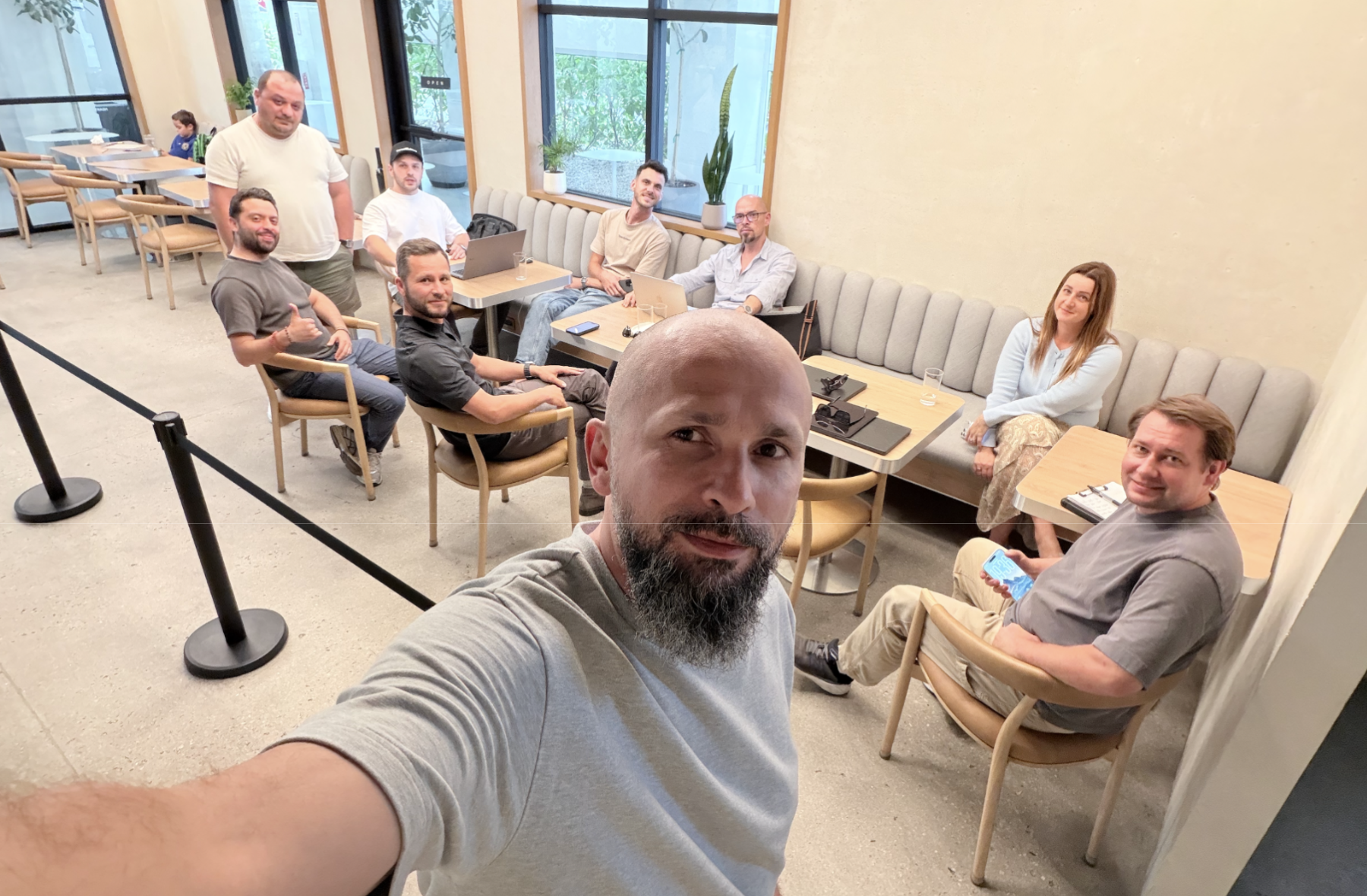
The photo at the top of this post is from one of the team meetings we held to prepare for this transition. Not a training session — a conversation and brainstorming. About what's coming, what it will require, what we're asking of each person, and what we're committing to in return.
These conversations matter more than the schedule spreadsheet. A team that understands why the standard exists and genuinely wants to hold it will find a way through the hard days. A team that is simply following instructions will drift the moment the instructions become inconvenient.
What we were asking in that room was not just for more hours. We were asking for the same level of care, the same attention to the guest, the same pride in the product — distributed across two more days per week, indefinitely. That's a significant ask. It deserves a real conversation, not just a new rota in the group chat.
The bakery challenge — temperature, timing, and no days off
The barista problem is visible and talked about. The bakery problem is less obvious but just as real.
Our kitchen and bakery share the same room. Croissant lamination requires cold — the butter needs to stay firm through every fold or the layers collapse and the result is bread, not croissant. The room needs to be around 68 degrees or lower before lamination can start. After a full kitchen service, that room is hot. So right now, we close the kitchen at 2pm and wait for the room to cool down before the lamination team can begin.
Sunday and Monday were our solution to this. With the café closed, the team could use those two full days for lamination without the temperature conflict, without time pressure of a kitchen running service simultaneously. It worked well. Those two days gave us the production capacity to supply the whole week.
With seven-day operations, those two days are gone. Which means the lamination team either works late after the kitchen closes — waiting for the room to drop to temperature and starting production that runs past midnight — or we find another way.
For now, we are solving it through scheduling: later lamination shifts, adjusted prep timelines, and a team that understands why this matters enough to work the hours it requires. It isn't elegant. It's a constraint we're operating inside until we build our way out of it.
The permanent solution is Three Sixteen Center. A dedicated lamination production space — separate from the kitchen, climate-controlled, designed for pastry production at scale. When that's built, every location in the network gets laminated dough produced under the right conditions, every day. The quality becomes independent of what the kitchen next door was cooking two hours ago.
Until then, we're managing the constraint. Constraints are what make you build things properly instead of just getting by.
What we're watching for
When we will go into the seven-day schedule we know that the first few weeks would be diagnostic. Not a crisis — a test. We will be watching specific things.
Product consistency across all days of the week. If the croissants on Sunday are measurably different from the croissants on Wednesday, something in the prep system has broken down and we need to find it before it becomes the new normal.
Team energy over time. Not in the first week, when everyone is focused and the newness of the change provides its own energy. Four weeks in, eight weeks in — that's when the structural sustainability of the schedule becomes visible.
Guest experience at the edges of the day. Opening and closing are the moments when shortcuts are most tempting and most damaging. The first guest of the morning and the last guest before close deserve exactly the same experience as the guest who arrives at peak hour. Holding that is a discipline issue, not a staffing issue.
Why we're doing this anyway
None of this is a reason not to expand. It's a reason to expand carefully — with the systems, the team, and the conversations that make the expansion sustainable rather than just additive.
The guests who couldn't come on Sundays deserve access to the café. The people who work Monday to Friday and never had a morning free deserve to be able to come in on a Monday. The community we're building doesn't stop at five days a week and neither should we.
But building something that holds its standard seven days a week, 52 weeks a year — that's the actual goal. Not just being open. Being worth coming to, every time, regardless of which day of the week it is.
We're not there yet. We're working on it. That's what this transition is.

.png)