

The cortado is the smallest, most honest drink on a specialty coffee menu. Equal parts espresso and steamed milk — nothing more, nothing less. No thick foam. No large cup. No flavoured syrup to hide behind.
If you've seen it on the menu and passed over it, or ordered it without fully understanding what you were getting, this is the explanation. The cortado is one of the best drinks in specialty coffee — and once you understand why it's built the way it is, you'll understand why a lot of serious coffee drinkers default to it.
What cortado means
Cortado comes from the Spanish verb cortar — to cut. The name describes exactly what the drink is: espresso that has been cut with a small amount of warm milk.
The milk doesn't dilute the espresso. That's the crucial distinction. It interrupts it — softening the sharp edges of acidity and bitterness while leaving the coffee's character intact. The result is something that tastes like espresso but without the aggression. Intense, smooth, and balanced in a way that neither straight espresso nor a milk-heavy drink quite achieves.
The word is doing real work. A flat white adds milk to extend the drink. A latte adds milk to soften it significantly. A cortado adds milk only to cut — to edit — the espresso, not to transform it.
What's in it
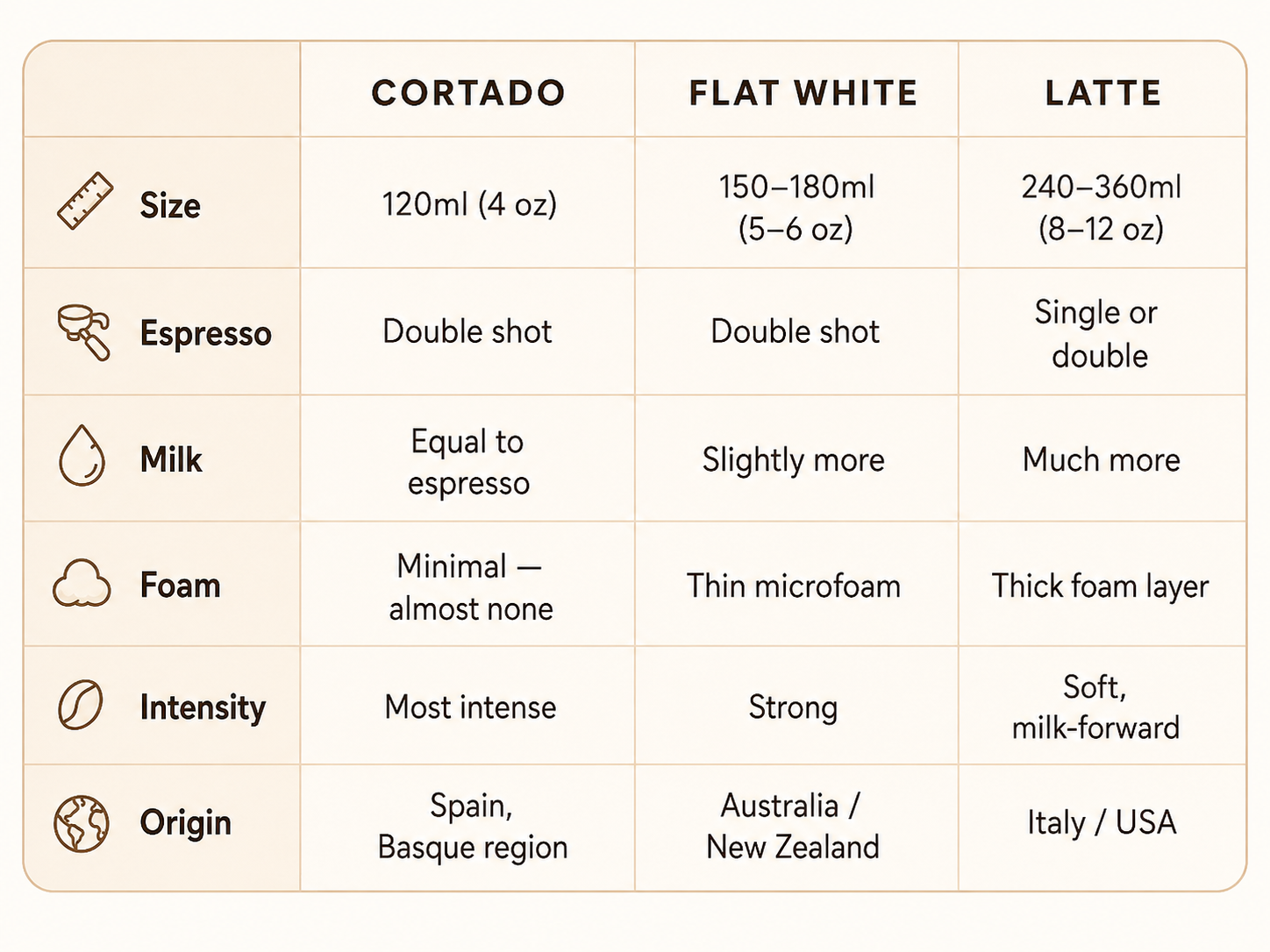
A cortado is a double shot of espresso — roughly 60ml — paired with an equal volume of steamed milk. Total volume: about 120ml, or four ounces. It is served in a small glass or ceramic cup, and the milk is steamed to a light microfoam with almost no foam layer on top.
The 1:1 ratio is the defining characteristic. In practice, some baristas work at 1:1.5 depending on the espresso profile and the milk, but the principle holds: the milk and espresso are in rough equilibrium, neither dominating the other.
What makes it different from a small flat white is primarily the milk texture and the foam. A flat white has more milk, a slightly larger volume, and a thinner but more intentional microfoam that integrates with the espresso. A cortado has less milk, minimal foam, and a more direct coffee-milk balance. The cortado is rawer. The flat white is a little more refined.
Where it comes from
The cortado originated in Spain — most specifically, the Basque Country in the north, where coffee culture was heavily influenced by the Italian espresso tradition but developed its own vocabulary and rituals. The drink was never designed to be exotic or special. It was a daily staple: pulled mid-morning or in the early afternoon, served in a small clear glass at the bar, consumed in a few minutes, and returned to the counter.
In Spanish and Portuguese café culture, the cortado is completely unremarkable — as ordinary as a drip coffee is in an American diner. It is the drink you order when you know what you want and don't need to think about it. The clarity of its construction is part of its identity.
It spread through Latin America, where in Cuba it became the cortadito — a sweeter version made with pre-sweetened espresso and sometimes condensed milk. In the United States, it arrived through specialty coffee culture and found its audience among people who wanted something stronger than a flat white but more approachable than straight espresso. Nation's Restaurant News noted that the cortado's appearance on mainstream American café menus signals a broader consumer shift toward smaller, more concentrated coffee experiences.
In Spain, a cortado is one shot of espresso with a little milk. The coffee was always the point — the milk was the edit.
What it tastes like
If you've only had lattes and cappuccinos, the cortado will taste stronger than you expect — and smoother than you expect at the same time. The espresso is present in every sip in a way it isn't in a latte. But the milk softens the acidity and rounds the bitterness, so the intensity is clean rather than harsh.
The temperature matters. Milk in a cortado is steamed to around 60 to 65 degrees Celsius — hot enough to be warm, cool enough to drink immediately without waiting. There's no thick foam sitting on top cooling the espresso down to the right temperature. The drink is ready when it's served.
The taste is best described as what espresso wants to be when it's made with good beans and good technique: bold, complex, slightly sweet from the milk, with the coffee's flavour notes — chocolate, fruit, nuts, depending on the origin — actually perceptible rather than buried under foam or diluted by volume.
If the espresso underneath is poor, the cortado makes it obvious. There is nowhere for mediocre coffee to hide in a drink this small and this direct. This is why the cortado is the drink serious coffee drinkers order when they want to understand what a café is actually doing — it is the most honest thing on the menu.
Who it's for
The cortado is for you if you find straight espresso too intense but feel like lattes and flat whites give you more milk than coffee. It's the midpoint — the drink that takes espresso seriously without making you drink it unsupported.
It's also the right drink if you want to taste what the coffee actually is. A cortado at a café that sources carefully and pulls shots with attention will taste noticeably different from a cortado at a place that doesn't. The drink has nowhere to hide — which makes it the best diagnostic tool for judging a café's coffee quality before you commit to a larger drink.
Order a cortado if: you want to taste the espresso, you prefer small drinks you can finish quickly, you find flat whites slightly too milky, or you want to understand what makes one café's coffee different from another's.
Don't order a cortado if: you want to sit with a drink for thirty minutes, you find espresso too intense even with milk, or you want something sweet — the cortado has no sweetness except what the milk brings naturally.
The cortado at Three Sixteen
The cortado is one of our most ordered drinks at Three Sixteen. That says something about our guests — they tend to be people who care about the coffee, who want to taste it, who aren't ordering a drink to hide the espresso.
We pull a double shot, steam whole milk to a thin and integrated texture, and serve it in a small ceramic cup. The ratio is close to 1:1. The foam is minimal. The espresso leads.
If you've never had a cortado and you want to understand what specialty coffee actually tastes like — what we're trying to do with every shot we pull — this is the drink to order. It will tell you more about the coffee in three sips than a latte will in twenty.