
In January 2020, a pound of ground coffee at a U.S. retailer cost around $4. By January 2025, it hit $7. By August 2025, it reached $8.80 — an all-time record.
That’s a 120% increase in five years. And if you’ve noticed your morning latte getting more expensive, your grocery bill quietly climbing, or your favorite café raising prices — this is why. Not one reason. Several, compounding on each other at the same time.
Here’s what’s actually happening.
The chain starts with Brazil
Brazil produces roughly 35% of the world’s coffee. Most of it is Arabica — the variety used in virtually every specialty café, and in most of the coffee that ends up in American cups.
In 2024, Brazil experienced its worst drought in over 70 years. Nearly 60% of the country’s land was under severe stress. Rivers dropped. Wildfires spread. In Minas Gerais — the heart of Brazil’s arabica belt, the state that produces more specialty-grade coffee than anywhere else on earth — there were weeks where rainfall fell to nearly zero. Not below average. Nearly zero.
Coffee trees are sensitive. Arabica especially. They need a precise balance of temperature and rainfall to flower, and those flowers become the cherries that become the beans. When that cycle is disrupted, you don’t just lose one harvest. You risk long-term damage to trees that take years to recover.
“The potential of the 2025/26 arabica crop is hanging by a thread.” — Carlos Mera, Rabobank agri commodities analyst
By February 2025, Arabica futures hit a historical record of $4.38 per pound — a level not seen since 1977. World coffee stocks, as of November 2025, reached their lowest point in 25 years.
Then Vietnam got hit
When Arabica supplies tighten, the industry turns to Robusta — the cheaper, hardier variety grown primarily in Vietnam, which produces about 97% of its crop as Robusta and supplies nearly a third of the global market.
Except Vietnam had its own crisis. In 2023–24, severe drought cut Vietnamese production by 20% — the smallest harvest in four years. Exports fell by 17%. The safety valve the market was counting on was itself broken.
The result: both major variety prices spiked simultaneously. Arabica up 50% year-over-year. Robusta more than doubling. Roasters who normally blend the two had nowhere to turn that wasn’t expensive.
Then came the tariffs
In 2025, the Trump administration imposed a 50% tariff on Brazilian coffee imports to the United States. Brazil had been the largest single supplier of coffee to the U.S., accounting for around 32% of all imports.
The immediate effect was dramatic. Brazilian coffee flows to the U.S. fell by nearly 53% year-over-year in September 2025. American roasters, who had been drawing down existing inventories, suddenly faced a supply cliff. Some rerouted purchases to Colombia and Mexico — paying 10% more for equivalent quality. Others warehoused Brazilian beans in Florida under bond to delay the tariff payment. Small and mid-sized roasters reported margins collapsing.
For a mid-sized U.S. roaster importing 10,000 pounds of Brazilian Arabica per month, the 50% tariff added an extra $17,500 in duties — per month. That cost goes somewhere. It goes to the café that buys from the roaster. And from the café, it goes to the cup you’re holding.
What this means for your café visit
The cost of green coffee — unroasted beans — is one of the largest variable expenses a café carries. When it rises 50%, the café has two choices: absorb the cost or pass it on.
Absorbing a 50% input price increase on a product that already runs on single-digit margins is not a real option. It’s a path to closure. So prices go up.
What’s happening in the market right now is that every layer of the supply chain is repricing simultaneously. The farmer gets more. The exporter gets more. The roaster pays more. The café pays more. And at each step, there’s a lag — contracts made six months ago, inventory that was purchased before the spike — that makes the full impact visible slowly, like a wave that takes a year to reach shore.
The wave is reaching shore now.
Is it going to get better?
Possibly — but not quickly, and not completely.
The World Bank projects that Arabica prices could fall by around 13% in 2026 as the Brazilian crop recovers — partly because 2026 is the “on-year” in the biennial production cycle, and partly because higher prices have encouraged farmers to invest more in their trees. Early estimates suggest Brazilian Arabica output could grow around 24% in 2026–27 compared to 2025–26.
The tariff situation has also begun to ease. The U.S. removed the additional 40% tariff on Brazilian coffee in late 2025, though the base 10% tariff remains. Brazilian flows to the U.S. are expected to normalize gradually as buyers restock.
But “some relief in 2026” is not the same as going back to 2020 prices. Global coffee stocks are at a 25-year low. Climate volatility is structural, not episodic — Arabica’s growing belt is under long-term pressure from rising temperatures, and some projections suggest suitable growing areas could shrink by half by 2050. The era of cheap coffee was already ending before the drought. The drought just accelerated it.
What it means for specialty cafés
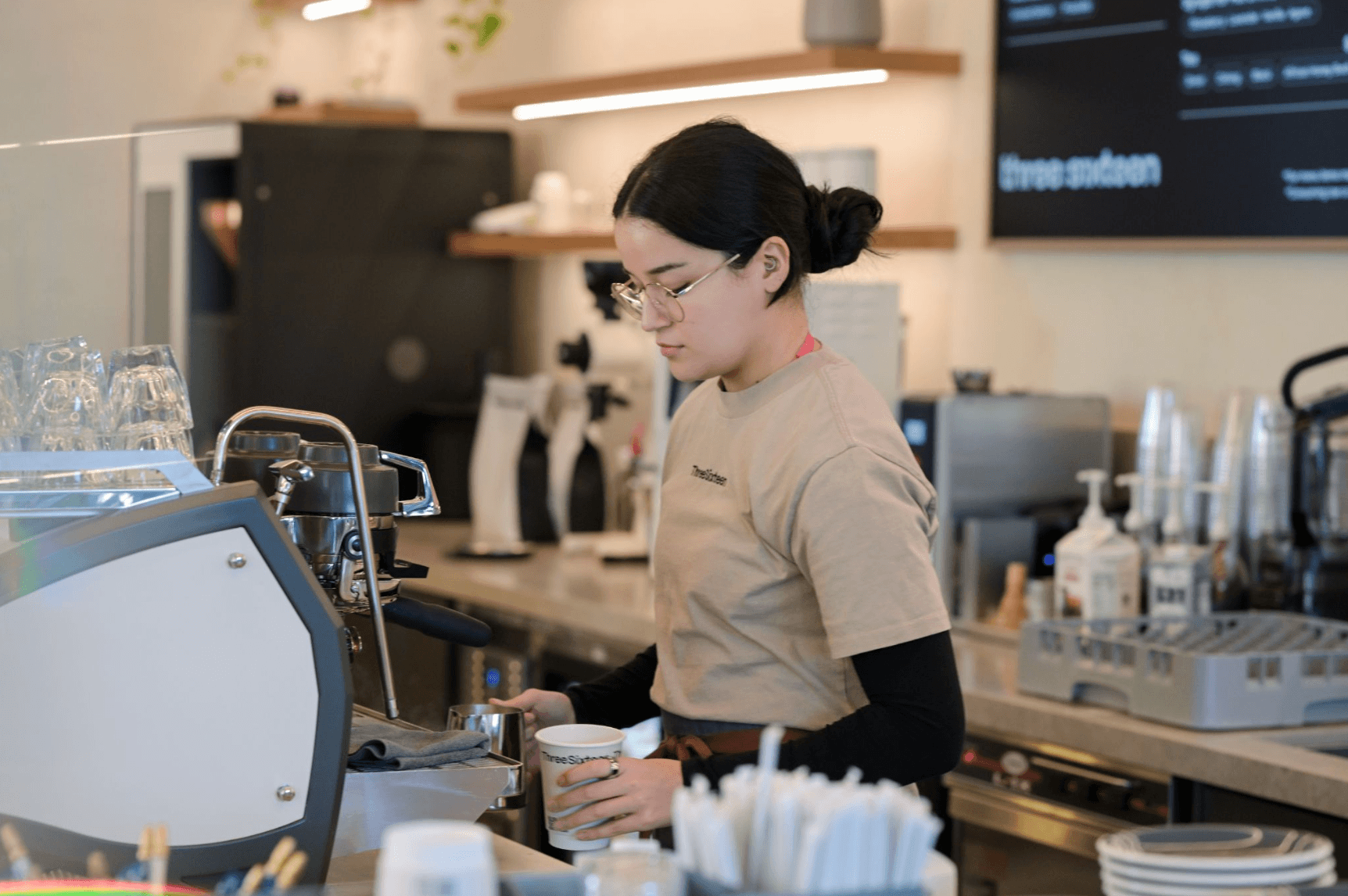
For a café like Three Sixteen, where quality is non-negotiable, this environment creates a real tension. The cost of the beans we use has risen significantly. The cost of butter, flour, eggs — everything in our bakery — has also risen. Labor costs are up. Rent doesn’t change because commodity markets are volatile.
We’ve had to make pricing decisions that we didn’t want to make. Not to protect our margin — we’ve already written about the fact that our first location’s margin is not where it needs to be. But to continue serving the quality we’ve committed to, at a cost structure that actually allows us to stay open.
This is the honest reality behind every price increase you see at an independent café right now. It’s not greed. It’s math.
The alternative — switching to cheaper beans, reducing quality to protect the price on the menu — is a choice some operators are making. We’re not one of them. If the coffee costs more to make well, it costs more to buy. That’s the deal we signed up for when we decided to do this properly.